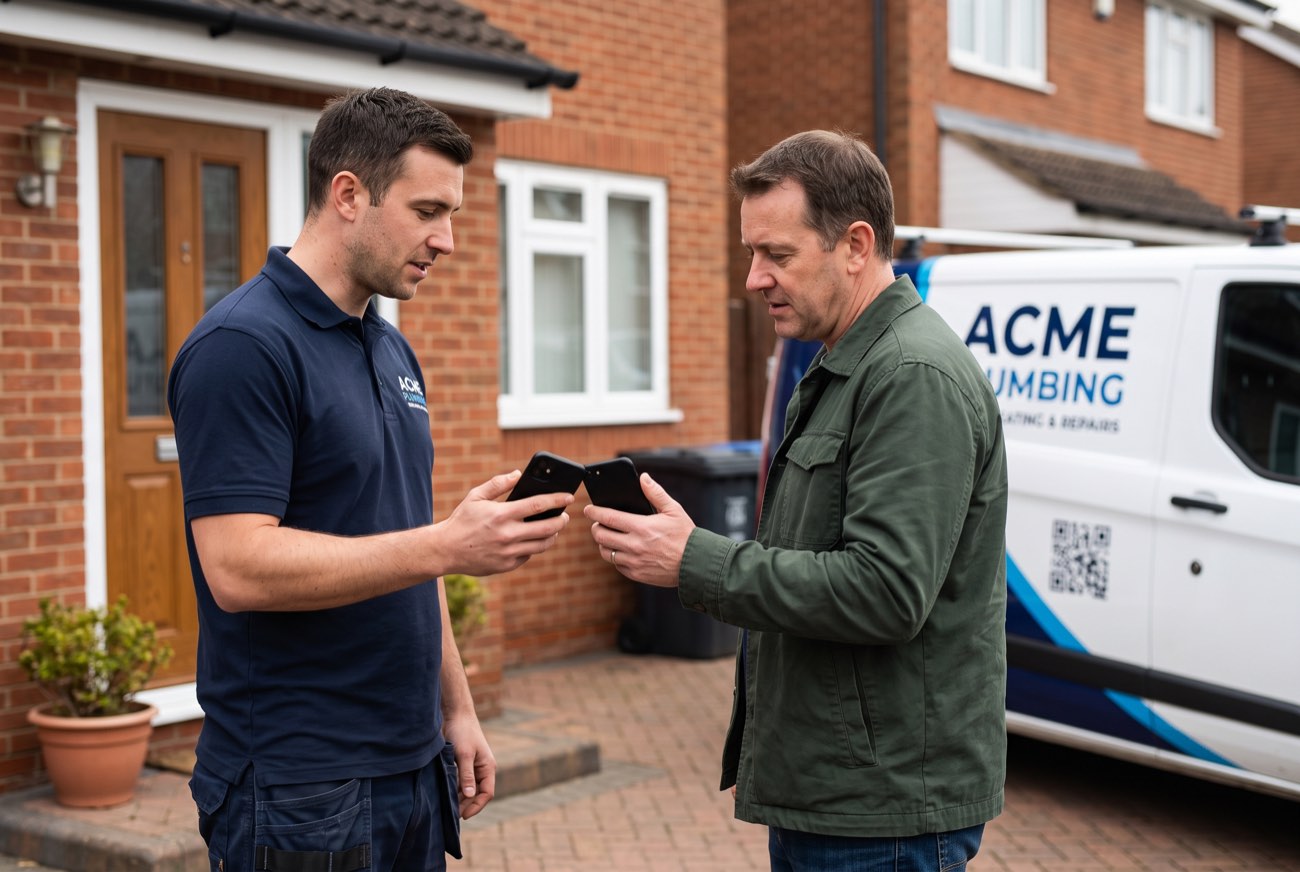
The quote goes to whoever gets back first. Every trade knows it, and almost every trade loses work to it — not through bad pricing, but because the details were on a card in a pocket that went through the wash on Sunday.
Here's what genuinely works when the office is a van.
Nobody types your number in
Watch what happens when a paper card changes hands on a job. It goes in a pocket. Later it goes on a worktop. At some point somebody decides whether it's worth typing seven fields into a phone. Usually it isn't, and by the time they want you they're searching a trade directory instead — where three of your competitors are paying to appear above you.
A card they tap puts you straight in their contacts. Name, number, WhatsApp, your work, your reviews, in one go. The comparison isn't "tap versus type". It's "in their phone versus in the bin".

Your prices change. Your card shouldn't have to.
The reason most trades stop reprinting cards is that something on them goes stale — a new number, a new van livery, a new limited company, a service you've dropped. So the old ones get handed out anyway, slightly wrong, for another eighteen months.
A digital card is edited once and correct everywhere, including on every card you handed over last year. That alone is worth more than the card.
Put it where the work is
The card in your wallet is the least useful place for it. The tradespeople who get the most out of this put a QR sticker on:
- The van — parked outside a job is your best advertising, and passers-by will scan a van
- The quote folder — so the customer can save you while you're still standing there
- The toolbox or the ladder — neighbours ask, constantly
- The back of the invoice — the moment they're happiest with you is the moment to ask for the review
All of those point at the same page, so you change one thing and every sticker updates.
Reviews, at the right moment
The best time to ask for a Google review is while you're packing up and they're pleased. Not three days later by text, when you've become admin.
Put the review link on the card as a button, hand them the phone, done.

Certificates and insurance, on your card
This is the part that matters on bigger jobs. Gas Safe, NICEIC, public liability, method statements — every trade has a folder of documents that a commercial customer or a letting agent will ask for, and everyone ends up emailing photographs of them.
Card1 has a document vault built in: the public certificates sit on your page ready to view, and anything private goes behind a share link you can set to expire. It turns "I'll dig it out and send it over" into a tap.

The card itself has to survive
Paper doesn't last in this trade, and neither does a printed plastic card in a pocket full of screws. That's why our card is engraved metal — it's the one that's still working in two years, and it's a one-off price rather than a subscription.
Start with the free digital card, put a QR sticker on the van, and see how many people save you in a fortnight. If it's earning its keep, add the metal one.